MOPSA is a static analyzer based on abstract interpretation. It analyzes C and Python code, and it’s written mostly in OCaml. Under the OCaml sits a stack of native libraries (GMP, MPFR, Zarith, Apron for the numerical domains, and LLVM/Clang to parse C) all bound to OCaml through its foreign function interface (FFI).
And I wanted to run it 100% client side in the browser, no server. The analyzer itself compiled to WebAssembly.
OCaml has had workable wasm solutions for a while, like wasm_of_ocaml. The hard part is everything around the OCaml. The FFI goes both ways (OCaml calls into C/C++, and C/C++ build and read OCaml values directly). Getting that mix (.ml + .c + .cc + generated camlidl FFI stubs) to agree on what an OCaml value is on wasm32 is where the real work lives.
The Dependencies
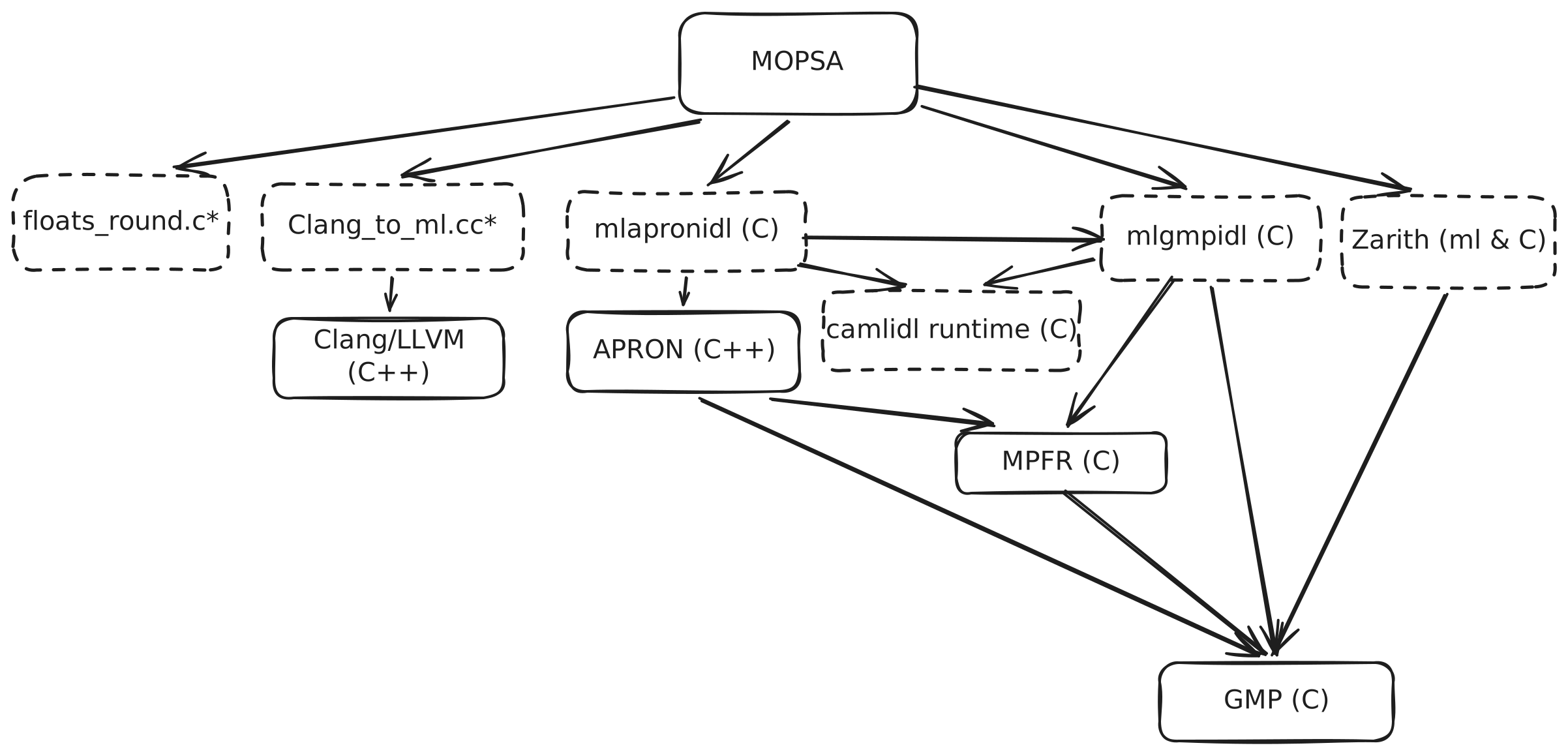
The diagram above shows every dependency that ships C or C++ code. The dashed ones use OCaml’s FFI in one way or another. It’s a bit of a mess, here are the spots worth paying particular attention to:
floats_round.cis a MOPSA-internal file that implements floating-point arithmetic with control over the rounding mode, which is useful for interval analysis. To do that, it relies onfesetround(declared in<fenv.h>) to set the floating-point rounding mode. Except there’s no equivalent in wasm, where everything is round-to-nearest, ties-to-even.Clang_to_ml.ccis a 5k-line MOPSA-internal file that bridges Clang and MOPSA. Its job is to take a C/C++ file, parse it with Clang, walk the AST Clang produces, and turn each node of that AST into an OCamlvaluethe analyzer can then manipulate.camlidlis a stub generator between OCaml and C, used notably by Apron and mlgmpidl. Any code it generates uses the OCaml FFI, and on top of that depends on the camlidl runtime, a set of “utility” functions.
So a lot of the C/C++ here doesn’t just compute and return, it allocates inside OCaml’s heap and reads the tags and fields of OCaml blocks. Every one of those call sites bakes in an assumption about what an OCaml value is, byte for byte, in memory.
The architectural bet
First, why not wasm_of_ocaml, js_of_ocaml, or wasocaml? They all share the same blind spot: they compile the OCaml and leave the C/C++ behind. That’s fine for a pure-OCaml project (or one whose few native dependencies already have a JS reimplementation, like zarith_stubs_js). But as far as I could tell, none of them offers a general escape hatch that doesn’t require hand-writing glue to bridge wasm and JS. In my case that would mean rewriting Clang_to_ml.cc entirely in JavaScript, and then maintaining that rewrite.
What I wanted instead was:
- As little code as possible, so the result stays maintainable.
- As few moving parts as possible. Getting a module compiled by
wasm_of_ocamlto talk to one compiled byemscriptenwould mean understanding, in depth, how each compiler lays out and manages memory, and then writing the plumbing to stitch the two together.
And there was a more concrete problem: what do I link the FFI stubs against? The C/C++ files that use the OCaml FFI call into runtime functions (caml_alloc, caml_callback, …). If I only compile the OCaml code, those symbols simply don’t exist, the stubs have nothing to link against.
After a lot of trial and error (much of it still visible in this repo), the answer turned out to be the OCaml runtime itself, it “provides an implementation” of all those caml_* functions.
And that quietly solves every point at once. I can lean on emscripten alone, because once I bring in the runtime I’m left with nothing but C and C++ to compile.
So the plan: compile the OCaml to bytecode, compile the OCaml runtime and all the native dependencies to wasm, link that native bundle together, then run the bytecode on top. And that should just work… right?
How do I link everything
Before thinking about compilation (something Emscripten handles well enough), it’s worth thinking about linking. The interpreter needs to find, at runtime, the C code behind each external declared in the bytecode. And there, OCaml resolves its C primitives dynamically via dlopen and dlsym.
How Ocaml bytecode looks for primitives
When you write external foo : int -> int = "caml_foo", the compiler never emits a direct call to caml_foo. It assigns it a number and emits a C_CALLn <index> instruction. The name-address binding is only resolved at program startup where OCaml dlopens the native libraries and dlsyms each primitive by name to fill a table of function pointers. At runtime, C_CALLn <index> is just caml_prim_table[index](args).
Emscripten does have a way to emulate dynamic module loading (SIDE_MODULE & MAIN_MODULE), but it’s complex to set up without editing too much Ocaml’s code and splits the binary into multiple wasm modules. Since keeping everything in a single static .wasm seemed simpler (and at 12 MB the result is still reasonable) I chose to short-circuit this mechanism entirely.
The OCaml runtime already has a static path for this. Before searching through .so files, lookup_primitive first checks a static table compiled into the runtime itself:
static c_primitive lookup_primitive(char * name)
{
  /* 1. built-in table, statically linked */
  for (int i = 0; caml_names_of_builtin_cprim[i] != NULL; i++)
    if (strcmp(name, caml_names_of_builtin_cprim[i]) == 0)
      return caml_builtin_cprim[i];

  /* 2. only then, dynamically loaded .so files */
  for (int i = 0; i < shared_libs.size; i++) {
    void * res = caml_dlsym(shared_libs.contents[i], name);
    if (res != NULL) return (c_primitive) res;
  }
  return NULL;
}
These two arrays, caml_builtin_cprim[] (the pointers) and caml_names_of_builtin_cprim[] (the names), are exactly what ocamlc -custom produces (Ocaml’s “fully static” mode): a generated file, conventionally called prims.c, that declares all the primitives of the executable and stores them in these two tables.
So then I supply my own prims.c containing all the primitives the MOPSA bytecode needs, and I disable the dlopen branch in the runtime (which has nothing to load anyway).
shared_libs (the runtime’s internal list of dlopened .so files) stays empty permanently. The second loop in lookup_primitive never finds anything: every primitive must be present in my built-in table, or the runtime halts immediately with unknown C primitive.
Building prims.c
The table must be a superset of everything the bytecode calls. I collect the primitives by scanning the C/C++ sources (both the runtime’s and every library I link) with a small script, extract-primitives.js. It follows the same idea as OCaml’s gen_primitives.sh (sed -n 's/^CAMLprim value \(…\)/\1/p') but is more robust, because MOPSA’s and Apron’s sources don’t always follow the CAMLprim value foo(...) convention.
~1435 primitives that contains: the runtime core (caml_*), unix (131 primitives), str, bigarray/int64, and the 655 Apron stubs generated by CamlIDL (camlidl_*_ap_*).
From that list, prims.c is generated with three sed passes in the Makefile:
$(BUILD_DIR)/prims.o:
	(echo '#define CAML_INTERNALS'; \
	 echo '#include <caml/mlvalues.h>'; \
	 echo '#include <caml/prims.h>'; \
	 sed -e 's/.*/extern value &();/'        backend/wasm/primitives.txt; \
	 echo 'c_primitive caml_builtin_cprim[] = {'; \
	 sed -e 's/.*/\t&,/'                      backend/wasm/primitives.txt; \
	 echo '\t 0 };'; \
	 echo 'char * caml_names_of_builtin_cprim[] = {'; \
	 sed -e 's/.*/\t"&",/'                    backend/wasm/primitives.txt; \
	 echo '\t 0 };') > $(BUILD_DIR)/prims.c
	$(EMCC) $(EMCC_FLAGS) -Wno-incompatible-function-pointer-types \
	    -c -I $(OCAML_STDLIB) -o $(BUILD_DIR)/prims.o $(BUILD_DIR)/prims.c
The generated file looks like this:
extern value caml_array_get();
extern value unix_read();
/* … 1435 lines … */

c_primitive caml_builtin_cprim[] = {
    caml_array_get, unix_read, /* … */ 0 };

char * caml_names_of_builtin_cprim[] = {
    "caml_array_get", "unix_read", /* … */ 0 };
Each primitive is declared extern value foo(); with no argument prototype. Their actual signatures differ (arities 1 to 5, plus N), but that doesn’t matter, the interpreter always recasts the pointer to the right arity at the call site (Primitive1(n), Primitive2(n), … in prims.h). Hence the -Wno-incompatible-function-pointer-types that silences the expected warning.
Compiling the ocaml runtime (libcamlrun.a)
I chose to use the latest OCaml 4 bytecode interpreter (4.14.2 when I started), as OCaml 5 introduces major runtime features such as domains and effects, which I expected would make compilation to and execution on WebAssembly more challenging. I did not investigate this further, although it may well be possible.
Compiling the runtime is fairly straightforward, with one small catch. OCaml 4.14 introduced runtime/sak, a tool run on the host to encode the stdlib path as a C string literal. emconfigure compiles it with emcc and produces a .wasm binary that cannot be executed natively and the build continues silently, the path stays empty, and the failure only surfaces at runtime. The fix is to compile sak manually with the real cc before calling make.
CFLAGS="$(CFLAGS)" $(EMCONFIGURE) ./configure \
    --disable-native-compiler \
    --disable-systhreads \
    --disable-ocamltest --disable-ocamldoc
rm -f runtime/sak runtime/sak.o runtime/sak.wasm
cc -c -o runtime/sak.o runtime/sak.c && cc -o runtime/sak runtime/sak.o
touch runtime/sak.o runtime/sak
CFLAGS="$(CFLAGS)" $(MAKE) -C runtime libcamlrun.a
The runtime/ directory contains the <caml/*.h> headers that define OCaml’s FFI API, the same headers every C stub compiled next depends on. Every subsequent compilation that touches the FFI passes -I$(OCAML_STDLIB), pointing at that same runtime/. This guarantees that stubs are compiled against the exact definitions of the runtime that will execute them.
Compiling MPFR & GMP (libgmp.a & libmpfr.a)
GMP and MPFR are the first two libraries to compile. Both build easily with Emscripten almost unchanged.
The pattern is the same for both: emconfigure ./configure followed by make. emconfigure rewrites the compiler environment variables (CC, AR, etc.) to point at the Emscripten toolchain, which is enough for the feature detection in configure to target wasm32 instead of the host.
# GMP
CFLAGS="$(CFLAGS)" $(EMCONFIGURE) ./configure \
    --disable-assembly \
    --host=none \
    --prefix=$(INSTALL_DIR)
$(MAKE) && $(MAKE) install

# MPFR (depends on GMP)
touch aclocal.m4 configure
find . -name "Makefile.in" -exec touch {} \;
CFLAGS="$(CFLAGS)" $(EMCONFIGURE) ./configure \
    --with-gmp=$(INSTALL_DIR) \
    --host=none \
    --prefix=$(INSTALL_DIR)
$(MAKE) && $(MAKE) install
Two details worth noting :
- For GMP,
--disable-assemblyis mandatory: GMP normally uses architecture-specific assembly routines (x86, ARM…) for performance, and Emscripten cannot compile them.--host=nonepreventsconfigurefrom detecting and using host-specific optimizations. - For MPFR, the
touchonaclocal.m4andconfigurepreventsmakefrom trying to re-run autoconf to regenerate theMakefile.infiles, which would fail inside the Emscripten environment.
The specific versions (GMP 6.1.2 and MPFR 4.2.2) are not arbitrary, they are the ones known to compile cleanly with Emscripten, identified in a Stack Overflow answer.
Compiling CamlIDL based stubs
CamlIDL is a stub generator. You give it an .idl file describing a set of C types and functions, and it produces two things: foo_stubs.c, containing the C functions that convert OCaml values to and from C, and foo.ml/foo.mli, the OCaml API. The idea is to never write the conversion plumbing by hand.
Two of MOPSA’s dependencies rely on this heavily: mlgmpidl (OCaml bindings for GMP and MPFR) and mlapronidl (OCaml bindings for Apron’s abstract domains). Together they account for roughly 655 of the ~1435 primitives in the final table.
CamlIDL runtime (libcamlid.a)
camlidl runs at build time to generate the required .ml and .c files. Every generated file depends on the CamlIDL runtime which is a set of three files (idlalloc.c, comintf.c, and comerror.c) that provide utilities for the generated code, mainly memory allocation and interface helpers.
Here is the Makefile rule used to compile these files:
$(LIBS_DIR)/libcamlidl.a:
    $(EMCC) $(EMCC_FLAGS) -D_FILE_OFFSET_BITS=64 -D_REENTRANT \
        -c -I$(OCAML_STDLIB) $(DEPS_DIR)/camlidl/runtime/idlalloc.c  -o $(BUILD_DIR)/idlalloc.o
    $(EMCC) $(EMCC_FLAGS) -D_FILE_OFFSET_BITS=64 -D_REENTRANT \
        -c -I$(OCAML_STDLIB) $(DEPS_DIR)/camlidl/runtime/comintf.c   -o $(BUILD_DIR)/comintf.o
    $(EMCC) $(EMCC_FLAGS) -D_FILE_OFFSET_BITS=64 -D_REENTRANT \
        -c -I$(OCAML_STDLIB) $(DEPS_DIR)/camlidl/runtime/comerror.c  -o $(BUILD_DIR)/comerror.o
    $(EMAR) rcs $(LIBS_DIR)/libcamlidl.a \
        $(BUILD_DIR)/idlalloc.o $(BUILD_DIR)/comintf.o $(BUILD_DIR)/comerror.o
Note the -I$(OCAML_STDLIB) flag that points at the OCaml FFI headers from the runtime we just compiled.
mlgmpidl and mlapronidl
Both mlgmpidl (GMP/MPFR bindings) and mlapronidl (Apron abstract domain bindings) follow the same pattern: use the upstream Makefile to generate the CamlIDL stubs as .c files, then compile each one with emcc. For example, mlapronidl:
$(MAKE) -C $(DEPS_DIR)/apron/mlapronidl CAMLIDL=$(CAMLIDL) PERL=$(PERL) $(MLAPRONIDL_IDL:%=%_caml.c)
for module in $(MLAPRONIDL_MODULES); do
    $(EMCC) $(EMCC_FLAGS) -c $(CAMLIDL_CFLAGS) \
        -I$(DEPS_DIR)/apron/apron -I$(DEPS_DIR)/apron/mlapronidl \
        -o $(BUILD_DIR)/$${module}.o $(DEPS_DIR)/apron/mlapronidl/$${module}.c
done
$(EMAR) rcs $@ $(addprefix $(BUILD_DIR)/,$(MLAPRONIDL_MODULES:%=%.o))
Compiling APRON
Each numerical domain (box, octagons, polka) is compiled as its own archive, compiled with -DNUM_MPQ:
$(EMCC) $(EMCC_FLAGS) -c $(CAMLIDL_CFLAGS) \
    -I$(DEPS_DIR)/apron/box -DNUM_MPQ \
    -o $(BUILD_DIR)/box_caml.o $(DEPS_DIR)/apron/box/box_caml.c
$(EMAR) rcs $(DEPS_BIN_DIR)/libboxMPQ_caml.a $(BUILD_DIR)/box_caml.o
NUM_MPQ tells Apron to use GMP’s exact multi-precision rationals (mpq_t) instead of hardware double for all bounds. Apron’s floating-point domains normally rely on fesetround to control hardware rounding direction, but WebAssembly has no FPU rounding mode control. With NUM_MPQ, every bound is computed exactly via GMP and fesetround is never needed.
While this reduces some floating-point imprecision, a source of unsoundness persists when APRON gets floats in its API before converting them to GMP rationals.
Compiling LLVM/Clang 9
A good chunk of LLVM is generated automatically by native tools (llvm-tblgen and clang-tblgen) that must run natively on the host machine.
The two-stage build
Stage 1: build the native tools.
cmake -G Ninja -S $(LLVM_WASM_SRC)/llvm -B $(LLVM_NATIVE_BUILD) \
  -DCMAKE_C_COMPILER=gcc-11 \
  -DCMAKE_CXX_COMPILER=g++-11 \
  -DLLVM_ENABLE_PROJECTS=clang \
  -DLLVM_TARGETS_TO_BUILD=host \
  -DCMAKE_BUILD_TYPE=Release \
  -DLLVM_BUILD_TOOLS=OFF \
  ...
ninja -C $(LLVM_NATIVE_BUILD) llvm-tblgen clang-tblgen
We build only llvm-tblgen and clang-tblgen, natively, with gcc-11. We use gcc-11 because the LLVM 9 code is no longer compatible with recent versions of gcc and clang.
Stage 2: build the wasm libraries
cmake -G Ninja -S $(LLVM_WASM_SRC)/llvm -B $(LLVM_WASM_BUILD) \
  -DCMAKE_TOOLCHAIN_FILE=$(EMSDK_TOOLCHAIN) \
  -DLLVM_TABLEGEN=$(LLVM_NATIVE_BUILD)/bin/llvm-tblgen \
  -DCLANG_TABLEGEN=$(LLVM_NATIVE_BUILD)/bin/clang-tblgen \
  -DLLVM_ENABLE_PROJECTS=clang \
  -DLLVM_TARGETS_TO_BUILD=WebAssembly \
  -DLLVM_DEFAULT_TARGET_TRIPLE=wasm32-unknown-emscripten \
  -DLLVM_HOST_TRIPLE=wasm32-unknown-emscripten \
  -DLLVM_ENABLE_THREADS=OFF \
  -DLLVM_ENABLE_ZLIB=OFF \
  -DLLVM_ENABLE_TERMINFO=OFF \
  -DLLVM_ENABLE_LIBEDIT=OFF \
  -DLLVM_ENABLE_LIBXML2=OFF \
  -DLLVM_ENABLE_ASSERTIONS=OFF \
  -DLLVM_ENABLE_EH=OFF \
  -DLLVM_ENABLE_RTTI=OFF \
  ...
The -DLLVM_TABLEGEN and -DCLANG_TABLEGEN flags point directly at the native tools we already built.
We don’t build all of LLVM.
ninja -C $(LLVM_WASM_BUILD) \
  clangFrontend clangParse clangAST clangLex clangBasic \
  clangSema clangDriver clangEdit clangSerialization \
  clangAnalysis clangStaticAnalyzerCore \
  LLVMSupport LLVMCore LLVMMC LLVMMCParser \
  LLVMBinaryFormat LLVMBitReader LLVMBitstreamReader \
  LLVMOption LLVMProfileData LLVMDemangle LLVMRemarks
No code-generation backend (LLVMX86*, LLVMAArch64*, etc.), no optimizers (LLVMTransformUtils, LLVMInstCombine, etc.). We only want the parsing frontend (lexer, parser, AST, semantics) and the minimal LLVM support it requires.
Compiling Clang_to_ml.cc
Clang_to_ml.cc is the heart of MOPSA’s C frontend. It’s a ~5000-line file that does two things at once:
- It drives Clang to parse a C file (via
CompilerInstance,ParseAST,RecursiveASTVisitor). - It allocates OCaml values and fills them with data from the Clang AST.
What makes this file special is that it includes both Clang headers and OCaml runtime headers at the same time:
// Clang headers
#include "clang/AST/RecursiveASTVisitor.h"
#include "clang/Frontend/CompilerInstance.h"
// ...

// OCaml headers
#include <caml/mlvalues.h>
#include <caml/alloc.h>
#include <caml/memory.h>
// ...
At each node of the Clang AST, the visitor creates a corresponding OCaml block with caml_alloc, stores fields into it with Store_field, and returns an OCaml value to the OCaml code that called into this C++. This is allocation inside the OCaml garbage collector’s heap, from C++, using the CAMLparam/CAMLlocal/CAMLreturn macros that maintain the GC’s invariants.
Compiling this file requires three sets of includes at once:
em++ -std=c++14 \
  -I$(LLVM_WASM_SRC)/llvm/include \           # LLVM headers
  -I$(LLVM_WASM_SRC)/clang/include \          # Clang headers (sources)
  -I$(LLVM_WASM_BUILD)/include \              # TableGen-generated headers
  -I$(LLVM_WASM_BUILD)/tools/clang/include \  # generated Clang headers
  -I$(OCAML_STDLIB) \                         # <caml/*.h> from the OCaml runtime
  -DCLANGRESOURCE=\"/clang-headers\" \
  -fno-rtti -fno-exceptions \
  -c $(CLANG_TO_ML_SRC) -o $(BUILD_DIR)/clang_to_ml.o
The -DCLANGRESOURCE="/clang-headers" is explained right below.
Clang’s resource headers
To parse C, Clang needs its own built-in headers: stddef.h, limits.h, __stddef_max_align_t.h, etc. These are Clang-specific headers, distinct from the system headers, that define the fundamental types and macros in a portable way. On a normal Linux system, they live in /usr/lib/clang/9.0.1/include/.
In a wasm binary, there’s no system filesystem. We preload them into Emscripten’s virtual filesystem:
ninja -C $(LLVM_WASM_BUILD) install-clang-resource-headers
# installs into $(INSTALL_DIR)/lib/clang/9.0.1/include/
And in the final link:
--preload-file $(INSTALL_DIR)/lib/clang/9.0.1/include@/clang-headers/includeClang_to_ml.cc is compiled with -DCLANGRESOURCE="/clang-headers", which tells Clang where to look for these headers in the virtual FS. Without it, the first #include <stddef.h> in an analyzed C file fails with a header-not-found error in the browser.
The final link: everything static
emscripten’s final link pulls everything into a single ocamlrun.wasm:
$(EMCC) ... -o $(DIST_DIR)/ocamlrun.js \
    --preload-file $(BUILD_DIR)/mopsa.bc@/build/mopsa.bc \
    $(LIBS_DIR)/*.a \
    -s ERROR_ON_UNDEFINED_SYMBOLS=1 \
    $(BUILD_DIR)/prims.o $(BUILD_DIR)/libcamlrun.a
Three things worth noting:
- Everything is statically linked:
libcamlrun.a(the interpreter),prims.o(the primitive table), and all the.aarchives (GMP, MPFR, Apron, the CamlIDL runtime, the OCaml Apron stubs (box/oct/polka), Zarith, Clang/LLVM, MOPSA’s C parser, and mylibmopsa_primitives.a(unix + str)). That’s what yields a self-contained.wasmof ~15 MB. ERROR_ON_UNDEFINED_SYMBOLS=1guarantees that every symbol named incaml_builtin_cprim[]actually exists in one of the archives. Ifprimitives.txtnames a primitive that nothing provides, the wasm link fails loudly rather than hittingunknown C primitiveat runtime, in the browser, at the worst possible moment.mopsa.bcis not linked, it is preloaded into emscripten’s virtual filesystem, then interpreted at runtime byocamlrun. It’s bytecode, not native code.
We did everything right, yet at runtime in the browser we hit an “index out of bounds”.
OCaml values at the FFI boundary on wasm32
The “index out of bounds” leads us straight into OCaml’s memory representation. An OCaml value is either immediate (an integer encoded directly in the word, with its low bit set to 1) or a boxed block (a pointer to a heap region preceded by a header word). That header, placed right before the pointer, encodes three fields: the tag (the low 8 bits, the block’s constructor, or Double_array_tag, String_tag, etc.), the wosize (size in words) and the GC color.
        Header                  block data
   ┌──────────────────┐   ┌──────────┬──────────┬─────
   │ wosize| col | tag│   │ field 0  │ field 1  │ ...
   └──────────────────┘   └──────────┴──────────┴─────
          val[-1]              ▲ val points here
Tracing the “index out of bounds” back to the macro, we land on OCaml 4.14.2’s form of Tag_val, in little-endian:
#define Tag_val(val) (((unsigned char *) (val)) [-sizeof(value)])My first thought was a bad compilation of sizeof(value) or a 64/32-bit mismatch. But sizeof is a compile-time constant, and it always evaluates to 4 here. The config is perfectly consistent under ILP32 (SIZEOF_PTR == SIZEOF_LONG == 4, and ARCH_SIXTYFOUR being undefined implies intnat == value == header_t == uintnat == 4 bytes), and no build path ever switches to 64 bits.
The real problem was subtler. The type of sizeof(value) is size_t, unsigned (4 bytes on wasm32), so negating it never produces -4, it wraps around into a large positive constant:
-sizeof(value) = -(size_t)4 = 0xFFFFFFFC   (unsigned wraparound, not -4!)
p[0xFFFFFFFC]  = *(p + 0xFFFFFFFC)
The negation itself isn’t the problem, the sign of the constant it leaves behind is. A genuinely signed -4, such as ((unsigned char *) val)[-4] or the -(int)sizeof(value) that the fix ends up using, compiles cleanly. Only the unsigned size_t form breaks, because it carries the positive constant 0xFFFFFFFC. Why that sign alone decides correctness comes down to how the compiler lowers the expression.
Clang doesn’t emit a memory access directly. It first lowers p[idx] into a getelementptr (GEP) in LLVM IR, the instruction that computes address = base + index × sizeof(element), and then the backend lowers that GEP, together with the load, into a native (or wasm) memory instruction. The C is identical on both targets, only this last step differs:
On native 32-bit, the effective address lives in a 32-bit register, and p + 0xFFFFFFFC is a plain 32-bit add. The add overflows and the hardware silently truncates modulo 2³², so the result is exactly p - 4. It is technically overflowing, but it “works” by wraparound, which is why upstream OCaml gets away with it on every 32-bit native platform, whatever the sign of the constant.
On wasm32, addresses are also i32, so you might expect the same wrap, but wasm has two ways to add an offset and they don’t agree. An explicit i32.add does wrap modulo 2³², and would have given p - 4. The other way is the static offset baked into the memory instruction itself, i32.load offset=N, where N is an unsigned u32 immediate. The runtime forms ea = base + N and bounds-checks ea + access_size against the linear-memory size on the full, untruncated value, with no wraparound. Because that immediate is unsigned, the backend can only fold a non-negative constant into it, and a negative displacement has to stay an explicit, wrapping i32.add. A signed -4 cannot go in the offset, so it survives as an i32.add and wraps to p - 4. Our unsigned 0xFFFFFFFC is a perfectly valid non-negative offset, so LLVM folds it into the load, and the runtime instead checks:
ea = p + 0xFFFFFFFC   ~ 4 GiB, no wraparound
ea + 1 > memory_size  -> trap -> out of bounds
That trap is the “index out of bounds” we saw. The unsigned 0xFFFFFFFC survives as a near-4 GiB constant offset that the bounds check rejects. Compiling the two forms side by side (the unsigned [-sizeof(value)] and a signed [-4]) with the project’s own compiler (emcc 4.0.22, clang 22) at -O2 produce these two wasm. Note that the difference is only signedness:
;; ((unsigned char *) v)[-sizeof(value)]   -- original, size_t offset
(func $tag_old (param i32) (result i32)
  local.get 0
  i32.load8_u offset=4294967292)            ;; 0xFFFFFFFC folded into the load -> traps

;; ((unsigned char *) v)[-4]                -- signed literal
(func $tag_signed4 (param i32) (result i32)
  local.get 0
  i32.const -4
  i32.add                                   ;; explicit wrapping add -> p - 4, fine
  i32.load8_u)
The folding is itself a property of this particular backend rather than of wasm as such. wasi-sdk clang 18 on the same machine declines to fold even the unsigned form, emits the wrapping i32.add, and the original macro happens to work there. So rather than rely on any backend folding the offset correctly, the fix simply never produces the unsigned constant in the first place:
#define Tag_val(val) (((unsigned char *) (val)) [-(int)sizeof(value)])Casting sizeof(value) to int before negating leaves a signed -4 instead of the unsigned 0xFFFFFFFC. The backend can’t fold a negative displacement into the load’s static offset, so it keeps the wrapping i32.add and computes p - 4 correctly, exactly the $tag_signed4 form above.
From a .wasm to a real app
At this point I have a 15 MB ocamlrun.wasm that can interpret mopsa.bc. But a .wasm isn’t an application: you have to instantiate it, hand it files to analyze, capture its output, and, for the interactive and debugger modes, talk to it while it runs.
A fresh instance per analysis
I start from a fresh instance for every analysis, because the OCaml runtime isn’t re-entrant. It leans on a whole pile of global state (the GC heap, the primitive table, the bytecode’s global variables), and mopsa.bc ends with an exit. Once main has returned, the instance is in a state there’s no clean way back from, so I can’t reuse one instance across edits.
Keeping a single instance with Asyncify (to suspend/resume the runtime around I/O) is the obvious alternative, but Asyncify is incompatible with OCaml’s exception mechanism because exceptions are built on setjmp/longjmp, and the two fight over control of the stack.
On the Emscripten side, a fresh instance per analysis comes down to MODULARIZE=1 plus an EXPORT_NAME:
-s MODULARIZE=1 \
-s EXPORT_NAME='createMopsaModule' \
Instead of instantiating the module at load time, Emscripten exposes a factory, createMopsaModule(config), that returns a Promise for a fresh instance, configurable per call. Each analysis calls createMopsaModule(...), lets main run, captures the output, then throws the instance away.
The virtual filesystem
MOPSA is a command-line tool that reads files, a config, stubs… In the browser there’s no filesystem, so we lean on Emscripten’s virtual FS. Two halves:
-
The static part, preloaded. Everything that never changes from one analysis to the next is packed into
ocamlrun.data(~21 MB) at link time, via--preload-file:--preload-file $(BUILD_DIR)/mopsa.bc@/build/mopsa.bc \ --preload-file $(INSTALL_DIR)/lib/clang/9.0.1/include@/clang-headers/include \ --preload-file $(LINUX32_INCLUDE_DIR)@/usr/include \ --preload-file $(DEPS_DIR)/mopsa-analyzer/share/mopsa@/share/mopsa \The
mopsa.bcbytecode, Clang’s built-in headers, the linux32 system headers MOPSA needs to analyze C, andshare/mopsa(the configs and the C/Python stubs) all land at fixed paths in the virtual FS. -
The dynamic part, written on the fly. The user’s code, their config, and any extra files are written right before launch, in a
preRunhook. For that I exportFS(to write the files) andENV(to set environment variables):-s EXPORTED_RUNTIME_METHODS="['FS','ENV']" \function makePreRun(code, config, codeFile, extraFiles) { return function (M) { if (M.ENV) M.ENV.TERM = "xterm-256color"; M.FS.writeFile("/config.json", config); // ... mkdirTree + writeFile for each extra file ... // The code file is written LAST so it overrides any stale entry. M.FS.writeFile(codeFile, code); }; }The
TERM = "xterm-256color"lets MOPSA emit ANSI colors in its output, which we then render withxterm.js.
The runner: mopsa_worker.ml
The bytecode’s entry point is a worker mopsa_worker.ml, compiled to bytecode (modes byte, -linkall, -no-check-prims). Its job is to prepare Sys.argv and the environement before delegating to Mopsa_analyzer.Framework.Runner
This matters mostly for multi-language C + Python analysis, where MOPSA (especially when there are several C files) expects a build DB (mopsa.db) to have been generated beforehand. I build that DB by hand from all the C files.
(* Multi-language: generate mopsa.db from the C files, pass only the entry .py. *)
let db_path = Filename.concat workdir "mopsa.db" in
generate_db db_path c_files;
let new_argv = Array.of_list (prog :: other_args @ [entry_py]) in
So mopsa_worker.ml splits argv into three (flags, .c/.h files, .py files), and if there’s both C and Python, it generates a mopsa.db in memory with Mopsa_build_db, drops it into the working directory, and passes only the Python entry point to the analyzer. This is what makes cross-C/Python analysis possible client-side (more on that below).
On the JS side, the buildArgs function fills out the command line with the virtual-FS paths:
function buildArgs(options, isHelp) {
  return ["build/mopsa.bc"]
    .concat(isHelp ? [] : ["-config", "/config.json"])
    .concat(["-share-dir", "/share/mopsa", "-I", "/clang-headers", "-I", "/usr/include"])
    .concat(options || []);
}
The API: window.mopsaJs
Everything goes through a global object, window.mopsaJs, installed by mopsa_api.js which is a synchronous script loaded before the React bundle, so the API is ready the instant React starts.
All the code state is kept in the main JS thread, I only reach for the wasm when it’s time to analyze.
All the “filesystem” helpers (writeFile, readFile, listDir, deleteFile, …) are backed by plain JS objects. Editing code, switching files, browsing the tree… all of it is synchronous and instant, never touching the WASM. The .wasm only comes into play when you call analyze().
On top of that, the Worker owns the binary. The .wasm (15 MB) and the .data (21 MB) are heavy, we don’t want to load them on the main thread, nor block the UI during an analysis that can take a while. analyze() just sends the current state to the Worker and returns a Promise resolved when the reply comes back:
analyze: function (options) {
  // ... (a fresher analyze() supersedes any in-flight run) ...
  return new Promise(function (resolve) {
    var id = _nextId++;
    _pending[id] = resolve;
    _worker.postMessage({
      type: "analyze", id: id, options: options || [],
      code: _code, config: _config, codeFile: _codeFile, extraFiles: _extraFiles,
    });
  });
},
The Worker and the cost of an instance
mopsa_worker.js fetches the .wasm and the .data only once, at startup. The .wasm is compiled up front into a WebAssembly.Module (via compileStreaming), and the .data is kept as an ArrayBuffer:
var _wasmModulePromise = WebAssembly.compileStreaming(fetch("./ocamlrun.wasm"));
var _dataBufferPromise = fetch("./ocamlrun.data").then(r => r.arrayBuffer());
For each analysis, we re-instantiate this already-compiled module (fast, no network) rather than reload everything. Two Emscripten hooks let us reuse these preloaded resources:
moduleConfig.instantiateWasm = function (imports, successCallback) {
  WebAssembly.instantiate(wasmModule, imports)
    .then((instance) => successCallback(instance, wasmModule));
  return {};
};
moduleConfig.getPreloadedPackage = function () { return dataBuffer; };
We pay for the compilation and the fetch once, and each run only pays for instantiation which is what makes “a fresh instance per analysis” affordable. The output is captured through the print/printErr callbacks. OCaml’s exit surfaces as an ExitStatus exception, which we recognize by its status field and treat as a normal termination.
The interactive and DAP modes
“Batch” mode is a simple round-trip, but MOPSA also has an interactive mode (a REPL where you step through the analysis) and a DAP mode (Debug Adapter Protocol). Both are a single, long-lived run that reads its stdin and blocks waiting for a reply.
The Worker runs the WASM synchronously, so when MOPSA reads stdin the Worker’s thread is frozen inside the read and can’t handle a postMessage that arrives in the meantime. This forces a synchronous stdin: a channel the Worker can pull a byte from in a blocking way, while the main thread writes to it asynchronously.
SharedArrayBuffer + Atomics.wait
The only web primitive that makes this possible is the SharedArrayBuffer / Atomics.wait pair. The Worker blocks on Atomics.wait until the main thread writes a message into shared memory and wakes it up. For this I use the small sync-message library (vendored), which wraps this protocol behind makeChannel / writeMessage / readMessage.
SharedArrayBuffer is only available if the page is cross-origin isolated, which requires two HTTP headers:
Cross-Origin-Opener-Policy: same-origin
Cross-Origin-Embedder-Policy: require-corp
Wiring a blocking stdin into Emscripten
Emscripten reads stdin through a char device whose read function is called one byte at a time, in a loop, until it returns null (which makes the current read() return). So we have to hand back one byte at a time, and return null at the end of each line to unblock read(). A delivering flag tells apart “I just finished a chunk” (return null, don’t block) from “the start of a fresh read” (block for the next message):
return function () {
  if (pos < buf.length) { delivering = true; return buf[pos++]; }
  if (eof) return null;                 // permanent EOF
  if (delivering) { delivering = false; return null; }  // end of the chunk
  flushOut();                           // see just below
  while (true) {
    var m = self.syncMessage.readMessage(channel, String(msgId++), {}); // blocks here
    if (m == null) continue;
    if (m.eof) { eof = true; return null; }
    buf = encoder.encode(m.data || ""); pos = 0;
    if (buf.length === 0) continue;
    delivering = true; return buf[pos++];
  }
};
While the thread is in Atomics.wait, microtasks don’t run. But output is sent to the main thread via a microtask. The mopsa >> prompt (no trailing newline, printed just before the read) would therefore stay stuck in the buffer and the user would see a frozen terminal with no prompt. So we flush the output synchronously (flushOut()) right before blocking.
On the output side, a byte sink collects the stdout/stderr bytes and postMessages them to the main thread (as a transferable, to avoid a copy). It normally batches through a microtask, but it also exposes that synchronous flush() the read calls before blocking. The same sink serves both modes: interactive sends the raw bytes to xterm, DAP reassembles them into Content-Length frames.
The interactive mode, UI side
Inside the WASM, stdin is a non-tty char device: tcgetattr fails, and MOPSA falls back to line-by-line Stdlib.read_line, with no echo. If we just relayed the keystrokes, the user wouldn’t see anything they type.
So the terminal does local echo and minimal line editing itself, then sends the whole line (plus "\n") to stdin on Enter:
for (const ch of data) {
  if (ch === "\r" || ch === "\n") {
    term.write("\r\n");
    session.sendInput(lineRef.current + "\n");
    lineRef.current = "";
  } else if (ch === "\x7f" || ch === "\b") {  // backspace
    // ... erase one character ...
  } else if (ch === "\x03") {                 // Ctrl-C : kill the run
    kill();
  } else if (ch === "\x04") {                 // Ctrl-D  EOF
    session.sendEof();
  } else if (code >= 0x20) {                  // printable char : echo
    lineRef.current += ch; term.write(ch);
  }
}
The engine’s output (prompts, results, ANSI colors) arrives as raw bytes and is written as-is into xterm.js, which renders the 256-color palette natively.
Misc fixes
Once the .wasm runs and analyses terminate, a handful of assumptions scattered across the native dependencies remain that no longer hold on wasm32, they silently compromise the soundness of the analysis rather than crashing it.
Apron, for its part, calls ap_fpu_init at startup, which probes the FPU via fesetround(FE_UPWARD). On wasm that probe necessarily fails. We short-circuit the function at link time with -Wl,--wrap=ap_fpu_init, and our override in backend/wasm/ap_fpu_wasm.c (__wrap_ap_fpu_init) simply returns true. Faking success is safe for the bound arithmetic: everything is compiled with NUM_MPQ, so bounds are computed with GMP’s exact rationals rather than the FPU. It does not make the FPU rounding mode controllable, as noted earlier, floats that reach Apron’s API before being converted to rationals can still round the wrong way, so a residual source of unsoundness remains.
Finally, MOPSA’s parser runs in two stages: Clang_to_ml.cc walks the Clang AST and mirrors each node into an OCaml value, then Clang_to_C.ml translates that raw Clang AST into MOPSA’s own internal C AST (T_pointer, T_record, …). In 32 bit clang produces types that weren’t handled by Clang_to_C.ml.
The trigger is va_list, whose underlying type Clang picks differently per target.
On x86-64, va_list is an array: __va_list_tag[1]. Like any array passed to a function, it decays to a pointer, so it reaches the parser as __va_list_tag *. A helper, fix_va_list, already recognizes that pattern and folds it back into the va_list typedef.
On 32-bit targets (i386/wasm32), va_list is instead a plain scalar, void *. And __builtin_va_start(ap, …) has to write back into the caller’s ap, so it takes that argument by reference. With no decay to hide it, Clang therefore hands the parser a reference to void *, an LValueReferenceType. Clang_to_C.ml’s type translator had no case for reference types, so it fell straight through to its catch-all:
| _ -> error range "unhandled type" (C.string_of_type t)which aborts with unhandled type: lvalue_ref(__builtin_va_list=void*). That blocked parsing of the CPython stub (share/mopsa/stubs/cpython/Python.c, PyErr_Format’s va_start) and therefore all cross C/Python analysis on 32-bit. Since a reference is ABI-equivalent to a pointer, the fix is just to model it as one, right before the catch-all:
(* References are ABI-equivalent to pointers; model them as such. These
   surface in C code via builtins such as __builtin_va_start, whose va_list
   argument is passed by reference when va_list is a scalar (a void
   pointer) on 32-bit targets, unlike x86-64 where it is an array that
   decays to a pointer (see fix_va_list above). *)
| C.LValueReferenceType tq -> T_pointer (type_qual range tq), no_qual
| C.RValueReferenceType tq -> T_pointer (type_qual range tq), no_qual
Acknowledgements
The OCaml WASM port builds on Vincent Chan’s work on ocaml-wasm (August 2021), which provided the original configure tweaks and the Unix stubs (unix_lib.c, socketaddr.c, unixsupport.c, …) needed to run the OCaml runtime under emscripten.
For compiling LLVM/Clang to wasm, Binji’s fork and his notes were essential to figuring out how to go about it.
The specific GMP and MPFR versions compatible with emscripten were found thanks to this Stack Overflow answer.
Thanks to Antoine Miné for guiding me through the MOPSA codebase and supporting me throughout this project.